blog
Life in the Lab: How Do We Know If a Potential ASO Therapy Works?
Spoiler: It’s more complicated than you might think.
by Katerina Anamisis
August 26, 2026
In my last blog, The Diagnosis that Changed my Trajectory, I shared how my brother’s diagnosis of Usher syndrome type II motivated me to seek research opportunities to develop therapies for this condition and ultimately led to where I am now: a researcher in the Holt/Géléoc at Boston Children’s Hospital developing and testing exon skipping therapies to address mutations in Usher syndrome-associated genes.
When patients and patients’ families hear about a new potential therapy, it is easy to assume that it is simply a matter of testing the therapy and delivering it to the patient as soon as possible. In reality, however, the process of going from bench to bedside is a lot more complex. In this month’s blog, I will be taking you behind the scenes and showing you how exon skipping therapies go from theoretical models and computational predictions to rigorous laboratory testing to the clinic.
Understanding the Genetic Cookbook
Before we discuss exon skipping, it is essential to understand what a gene is. Your genome is like a cookbook that is composed of individual recipes, with each recipe representing a single gene. Each gene is responsible for encoding information that creates proteins that contribute to traits like hair color as well as provide the essential functions your body needs to survive.
Some of those ‘recipes’ are involved in hearing, vision, and balance; when those instructions are altered due to genetic mutations, the production of the resulting protein can be disrupted, leading to conditions like Usher syndrome.
What is Exon Skipping?
There are many therapeutic strategies that are currently being explored to address these mutations. One of these techniques involves using an adeno-associated viral vector, which is like a package that can be used to deliver a new, correct copy to cells where the original ‘recipe’ was altered by a mutation. An advantage of this approach is that it can help any patients with mutations in the same gene. However, if the gene is too large, it might not fit into the package vector, and so delivering an unaltered original copy is not possible. Some Usher syndrome genes are too large to fit into a single vector, so other therapeutic strategies are being explored until researchers develop a larger delivery system.
One of those approaches is exon skipping. In our cookbook analogy, each individual step in a recipe represents an exon. If one step is incorrect, the resulting dish may not turn out properly. Exon skipping works by placing a sticky note over the specific step that is altered. This can be used to mask that step so that the cell’s machinery will skip it and proceed to the next. This can avoid a faulty step from being executed so that it doesn’t ruin the whole ‘dish.’ Even though the dish may differ slightly from the original, it can still be better than the dish that would have resulted if the incorrect step was carried out. It’s important to note that this will only work if the step that you are trying to skip is not essential to the dish. As such, it is important to consider where a patient’s mutation is located, so you can gain a better idea of how essential that part of the recipe is and whether exon skipping could be a potential therapeutic option.
Developing and Testing the ASOs
The ‘sticky note’ itself is called an antisense oligonucleotide, or ASO. First, we design many potential ASOs through manual designs and computer-based predictions that tell us which candidates have a higher likelihood of efficiently skipping, although these predictions alone are never enough. After evaluating the ASO candidates and determining which ones we think are best, we place the order and the ASOs are synthesized by a company. Once the ASOs arrive at our lab, we introduce them to cells – or perform a transfection – and give the cells time to absorb the ASOs. The cells we use must be similar to the cells that are affected by the disease. So, we test in retinoblastoma cells, since these cells are fairly easy to grow and express many retinal genes that are associated with Usher syndrome. This step is necessary before we perform an assessment of the ASOs in more advanced models.
How Do We Know an ASO Worked?
After we let the cells sit for some time and take in the ASOs, we extract the RNA from those cells. The DNA serves as the original recipe, and the RNA resembles a photocopy of the recipe that the cells are actively using. We next do an experiment called reverse transcription-polymerase chain reaction, or RT-PCR, which allows us to make hundreds of copies of the RNA. This step is essential since it is challenging to detect exon skipping with only a few photocopies.
Next, we run the samples on a gel, where the longer RNA molecules will travel slower than the shorter copies. The skipped product (shorter) would be expected to travel both faster and further than the non-skipped product, so a band that appears further down on the gel where we would expect could indicate successful skipping. To confirm skipping actually occurred, we physically excise the band from the gel and send the product for sequencing, where the RNA is read letter by letter. This helps us confirm whether the exon was successfully skipped, as well as verify that there are no other unintentional skips occurring.
Another tool that we scientists use to validate exon skipping is adding a fluorescent protein, such as a green fluorescent protein. The assay can be designed such that the fluorescent molecule would only fluoresce upon successful skipping. So, if the ASO we designed successfully skips, the protein will fluoresce and the cells will appear a certain color (dependent on which fluorescent protein you choose to use) under the microscope, which would provide a visual indicator that the therapy is working.
Why does it take so long?
You might think that testing ASOs is a straightforward process. In reality, though, this is far from the case. After designing the ASOs, we must test them at different dosages, in different cell types, and under different experimental conditions to determine which conditions work best. There are times when ASOs do not work as expected, even if the computational software predicts a high likelihood of skipping. If this occurs, we must go back to the drawing board and redesign, reorder, and repeat the whole process again. Moreover, even after we demonstrate an ASO we designed is successfully skipping, we must determine how safe it is and make sure that it doesn’t unintentionally affect other genes or regions of RNA, which could have undesirable consequences.
We also want to test the ASOs in organoids, which are three-dimensional collections of cells that closely resemble the real tissue we are trying to test in. These organoids can be generated from patient-derived stem cells, which allows us to test whether the ASOs successfully skip in tissue that has the same genetic mutation as the patient. In the context of Usher syndrome, we test our ASOs in retinal and inner ear organoids, since the condition affects both vision and hearing, respectively. I will share more details about the process of generating organoids for our studies in one of my next blogs, and why it can take more than a year to generate these organoids… if everything goes smoothly.
Before advancing to clinical trials, we want to make sure that the therapy we are testing will work just as well in the body as it does in the cells we are testing. So, we collaborate with labs to generate animal models, such as mouse and zebrafish models, that exhibit similar genetic changes (more to come on this topic as well in future blogs).
Why Every Step Matters
As someone whose brother has Usher syndrome, I understand the urgency of this progressive condition and how difficult it is to wait for treatments to be brought to the clinic. Before I started my research, I did not understand why it would take so long for therapies to be developed. I thought it was simply a matter of identifying the therapy, testing it a couple of times, and delivering it to patients. I did not realize the complexity of the process and the importance of testing and retesting to ensure the results are accurate and that the ASOs we design are, in fact, both effective and safe.
My perspective has changed as I’ve gained more experience working in the lab. I’ve realized over time why it is essential to do each step thoughtfully rather than rushing the process. Rushing experiments can waste costly reagents, generate results that are unreliable, or potentially bring forward a therapy that is not as safe and/or effective as patients deserve. Over time, I’ve come to understand that the time spent testing and retesting isn’t lost – it’s time invested in providing patients with the safest and most effective therapy possible.
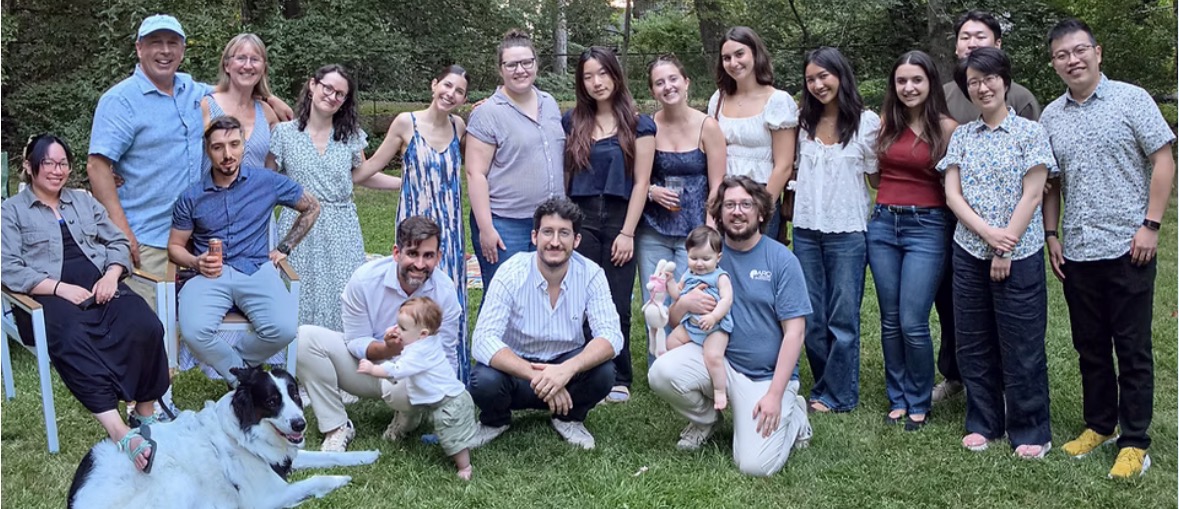
Holt/Géléoc Lab Summer BBQ and farewell celebration for Thibault and Evan
Explore more Blog posts
From the Fast Lane to the White Cane by Carlos Harris
blog From the Fast Lane to the White Cane by Carlos HarrisSeptember 28, 2026 Life in the Fast Lane My name is Carlos and I have Usher syndrome type 2a. I am a 67-year-old gay man, am a 40-year HIV survivor and for the first half of my life, my world moved at a...

Swimming for a Cure: Support USH X Swim Alcatraz 2026 by Pam Aasen
blog Swimming for a Cure: Support USH X Swim Alcatraz 2026 by Pam AasenSeptember 17, 2026 In 2009, when Ethan was seven and Gavin was five, our family received the Usher syndrome type 1b diagnosis that completely rewrote our lives. We already knew our sons had...
The Starting Line by Sara Jessick
blog The Starting Line by Sara JessickAugust 25, 2026 My First Usher Syndrome Conference I stood near my apartment door, my carry-on suitcase full of clothes that I had carefully curated for several “first-impression moments” in my immediate future. And despite being...
Help us find treatments and a cure.