
blog
A Circle of Art: Part 1: Finding Art
by Shawn Hewson
November 18, 2026
It was the summer of 1984, when I was 16 years old, that I found myself struggling with anxiety and searching for a sense of belonging while navigating the daily limitations of having a dual-sensory loss. I had just completed my sophomore year at Chisago Lakes High School in the rural town of Lindstrom, Minnesota (population 2,000), yet even in such a small, familiar community, I felt isolated.
That sense of isolation had been building for nearly a decade, ever since I was diagnosed with Usher syndrome at the University of Minnesota in 1975, at just seven years old. It was during a T-ball game at a sunken baseball field across the street from our home that something first appeared out of the ordinary with my vision. Playing in left field on a warm summer evening, a fly ball was hit in my direction and landed somewhere near me. As the infielders screamed for the ball, I frantically whirled around, completely unable to locate that white, three-inch round object. While both of my parents watched from the stands in bewilderment, the batter scored an inside-the-park home run before my teammate in center field could finally retrieve the ball.
That moment was especially crushing because I had already been diagnosed with profound hearing loss three years earlier, requiring two behind-the-ear (BTE) hearing aids that I kept hidden under my long brown hair. Learning that I also had retinitis pigmentosa, and would progressively lose my vision, was devastating, especially for a kid who loved sports.
Usher syndrome didn’t stop me from playing sports, but it changed the sports I played. I yearned to somehow overcome my limitations in sports and be that star player, but for the most part, frustration remained and the incidents piled up. There were simply too many fast-moving parts to follow with my tunnel vision and the difficulty hearing what was being communicated, pulling me further into my shell. I still played baseball until tenth grade but also turned to individual sports like bowling and golf, which moved at a slower, more accommodating pace. As a result, bowling became my favorite sport to this very day. I also tried adaptive hockey later in life from 2018-2022.
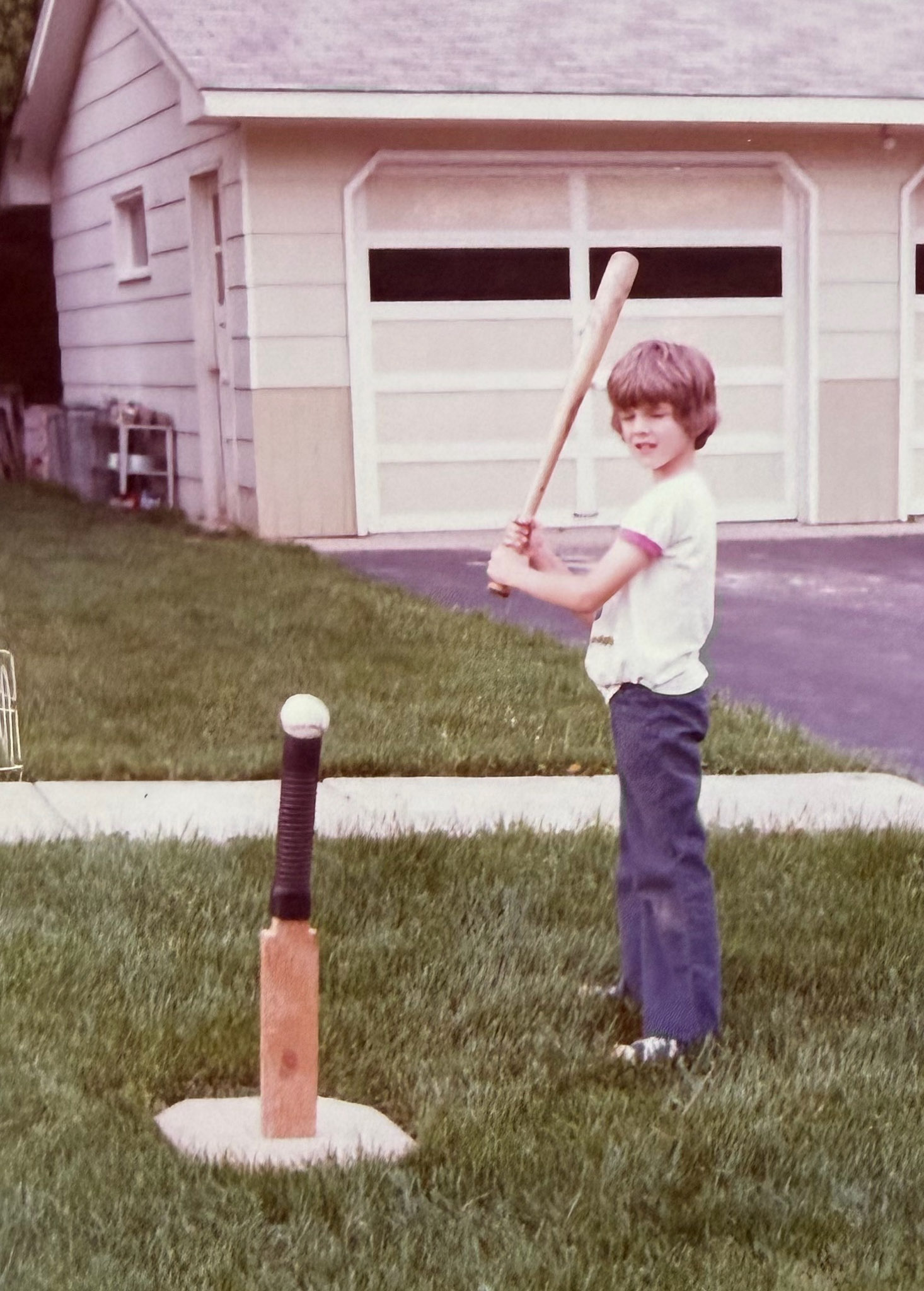
Shawn in 1975 at age 7 standing on the front lawn of his home with the garage in the background. He is holding a bat ready to hit a ball on a T-ball holder.
Growing up in Lindstrom, most of my time was spent working as a paper carrier and lawn caretaker, playing baseball, bowling in a Saturday morning league, and hanging out with just a few close friends and cousins. I even drove a snowmobile around town and across the surrounding frozen lakes during the winters, though certainly not without incidents. I made excuses not to attend many of the social events that I felt would be too difficult to navigate and interact with others. Most of the time, I just preferred to be alone because it eliminated anxiety as well as any potential incidents. I simply didn’t have the courage to fully advocate for myself and be honest about what I needed. As a result, I missed out on a lot of things during those years. Something was needed to pull me out of my shell.
The Brochure
One day during that summer of 1984, my mother approached me with a brochure we had received in the mail. The brochure highlighted a Family Learning Vacation (FLV) experience at Gallaudet University in Washington, D.C. Gallaudet is an institution dedicated to the education of students who are deaf, hard-of-hearing, deafblind or somewhere in between. The purpose of the weeklong program was to build community, connections, and communication skills for people like me.
Located on the same campus was the Model Secondary School for the Deaf (MSSD). Attending the FLV would also give us the opportunity to explore whether I should transfer to MSSD for my upcoming junior year of high school. As difficult as it would be for my parents to send me so far away, I knew they wanted whatever was best for my future,
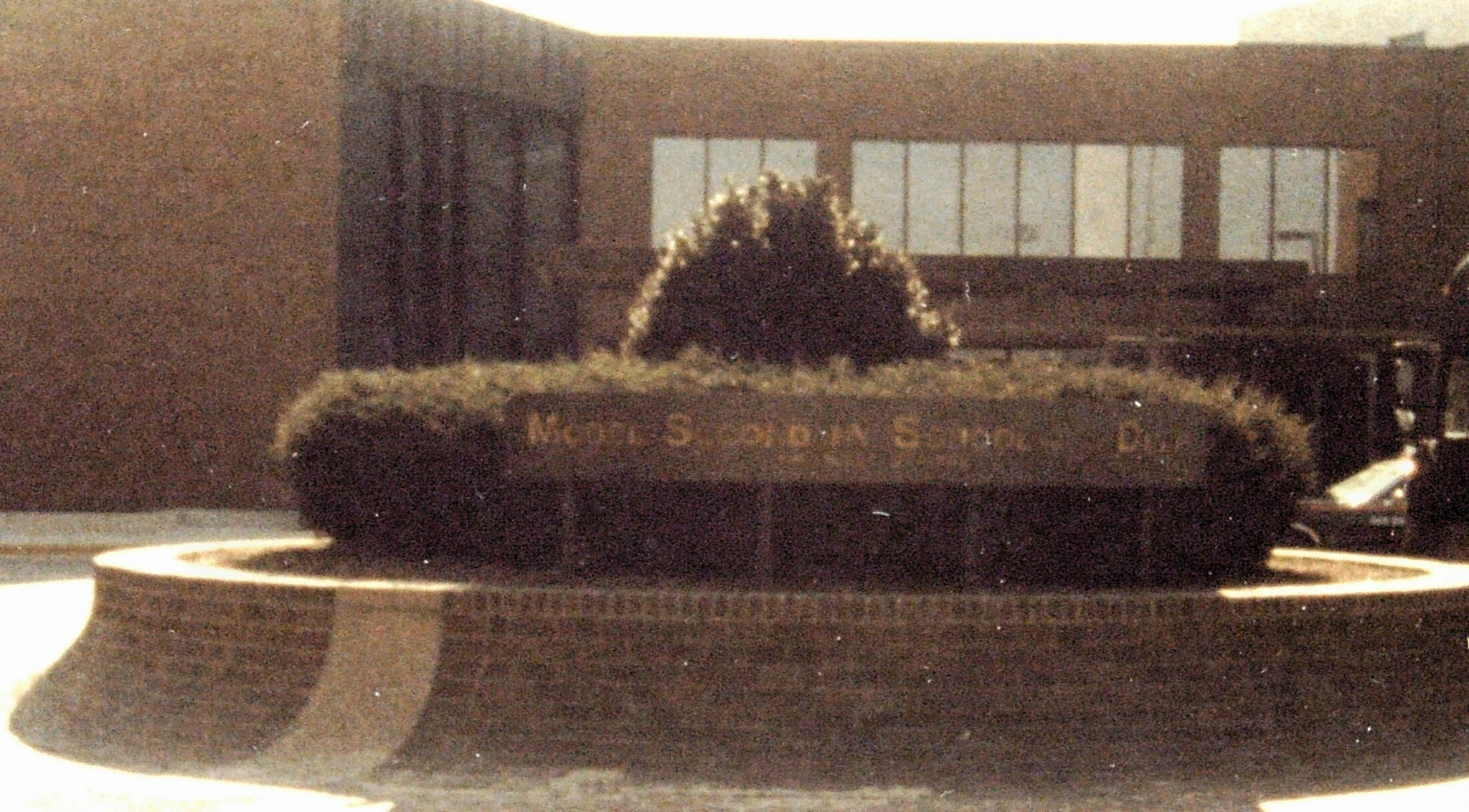
A picture from 1984 showing the main entrance of MSSD school with a large circular landscape structure in front with a sign that says ‘Model Secondary School for the Deaf.’
Maybe this was the missing piece of my puzzle.
There wasn’t much time to deliberate but after encouragement from everyone and some initial reluctance on my part, I gave the green light. It would be the first time I had ever been on an airplane. Up until that point, all our family vacations had been road trips in our comfortable station wagon, with our luggage strapped to the roof and sleeping bags rolled out in the back, seatbelts optional. On that first flight, high above the clouds, the cabin pressure caused my ears to plug up completely, leaving me unable to hear anything at all. Then, excruciating ear pain set in, forcing me to chew bubble gum and keep my jaws moving throughout the long two-and-a-half-hour flight.
Just before landing along the Potomac River, I was glued to the window with my Kodak disc camera, snapping blurry photos of the Washington Monument, the Lincoln Memorial, and other fascinating sights that caught my eye. Once the plane came to a complete halt at the gate, my hearing gradually came back to life along with some much-needed relief from the pain (This became a pattern my ears would repeat on flights for years to come). Later, after getting off the plane, I found myself riding in a taxi for the first time, something I had only ever seen in movies and on TV.
Meeting Art
Arriving on the Gallaudet campus was a complete culture shock. I had never met a culturally Deaf person before, nor had I ever been exposed to sign language. However, I had attended Camp Courage in Golden Valley, Minnesota, back in 1977, where the campers in my cabin were all hard of hearing and used their voices to communicate. This was an entirely new kind of experience. We met the other families and settled into our college dorm rooms. The weeklong agenda consisted of workshops, fun activities, learning sign language, touring the campus, and sightseeing around Washington, D.C.
On one of those days, the families gathered in a small room, sitting together in a half-circle formation. A man walked in with the help of a guide. His name was Arthur (Art) and he was deafblind. Art was the director of the Hearing and Vision Impaired Programs within Gallaudet’s division of Public Services. He sat down and greeted all of us with a lasting smile while using sign language that was translated by a voice interpreter. I was unexpectedly sitting next to someone else with Usher Syndrome for the first time in my life.
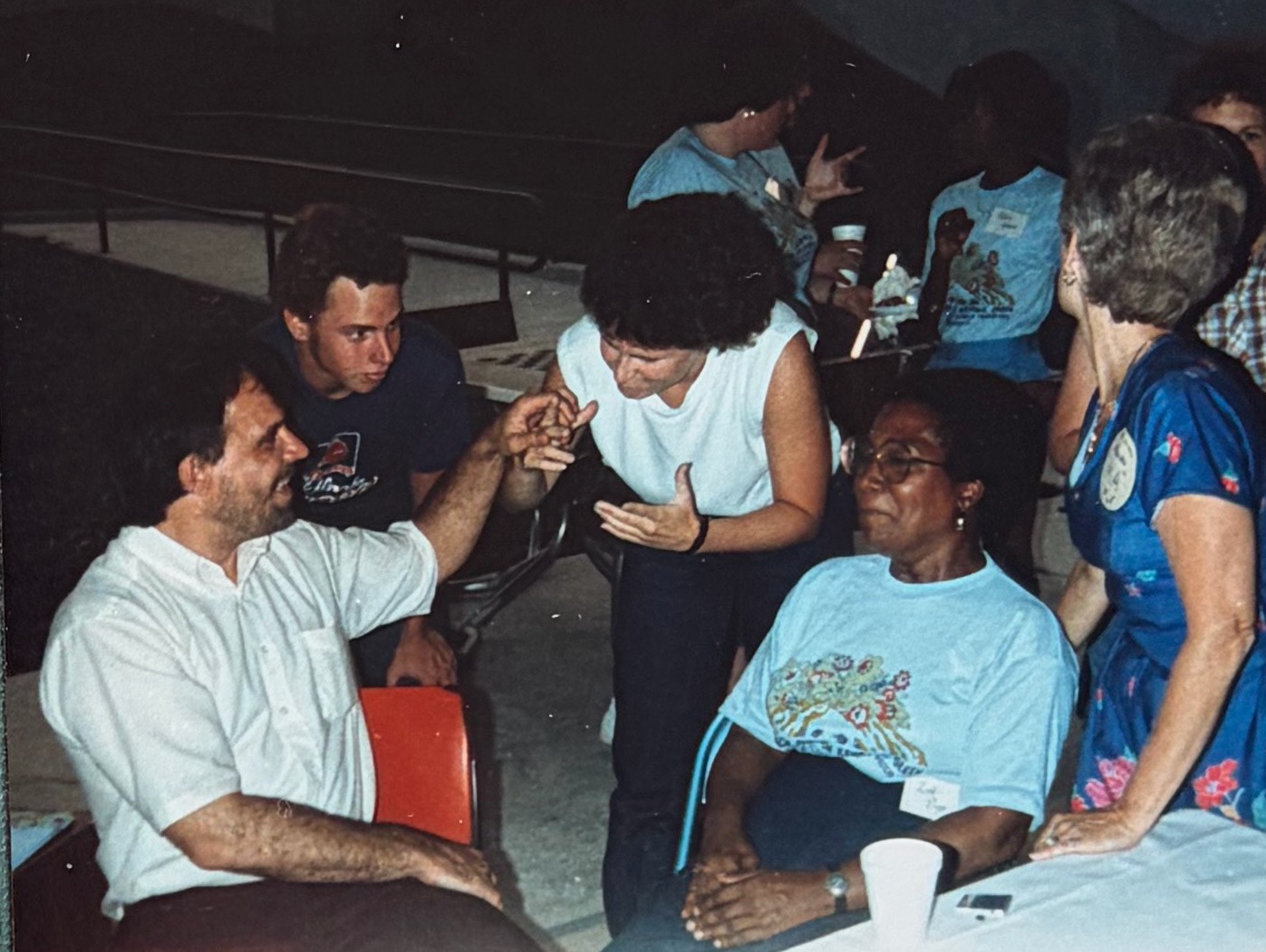
A picture from the Family Learning Vacation at Gallaudet University in 1984. Art is in the white short-sleeve polo shirt surrounded by parents and students with hearing loss. Art has his left hand resting on top of a woman interpreter’s right hand as she is bending close to him using tactile sign language.
It was so inspirational as we listened to Art share about his life and the school while filling us with hope and encouragement. I can honestly still hear the interpreter’s voice in my head to this very day. When we asked questions, Art would put his hand on top of the interpreter’s hand as she used tactile sign language to translate what was being asked. My parents and I were amazed with his effective communication skills and positive perspectives.
At the end of the session, we each had the opportunity to meet with Art individually and that encounter has never left my memory. It was surreal to get a glimpse of what my own future could look like with Usher syndrome. More importantly, it was the realization that I wasn’t alone with this degenerative condition, and that there were many resources available to help with my needs. Sometimes, you really do have to travel a thousand miles to find your answers.
That day was truly a turning point in my life. I knew right then that attending MSSD was the right step for me; which meant I needed a crash course in sign language immediately. A sign language interpreter spent a lot of time with us that week and taught me the basic signs to get started. It was an overwhelming experience because I wasn’t able to latch on to the word signs quickly, although the letters and numbers were more manageable due to their simple and stationary form. I was too analytical of the word signs as my way of memorizing rather than perhaps just focusing more on muscle memory like with a musical instrument.
The week flew by and it was already time to head back home to Minnesota. On that taxi ride back to the airport, I suddenly realized how much I had learned in just one week. And just like at Camp Courage, I did not want to leave.
(To be continued in Part 2…)
Explore more Blog posts
The Winding Road to Diagnosis: My Usher Syndrome Story by Samantha Murphy
blogThe Winding Road to Diagnosis: My Usher Syndrome Storyby Samantha MurphySeptember 18, 2025 A Family History of Vision Loss My name is Samantha Murphy, and in January 2025, at age 52, I learned that I am going blind. I was diagnosed with Usher syndrome Type 2A, but...
Motherhood, vision loss, and finding connection in unexpected places by Meagan Moore
blogMotherhood, vision loss, and finding connection in unexpected places.by Meagan MooreSeptember 4, 2025 An Unforeseen Path There are mornings when simply getting out the door feels like an obstacle course with one child searching for a missing shoe, another in tears...
Life with Usher Syndrome: Finding Purpose Through Connection and Advocacy by Laurie McBride
blog Life with Usher Syndrome: Finding Purpose Through Connection and Advocacyby Laurie McBrideAugust 25, 2025 Living with Usher syndrome has been quite a journey for me marked by evolving challenges, resilience, and self-discovery. It was a journey that started long...
Help us find treatments and a cure.