blog
From the Fast Lane to the White Cane
by Carlos Harris
September 28, 2026
Life in the Fast Lane
My name is Carlos and I have Usher syndrome type 2a. I am a 67-year-old gay man, am a 40-year HIV survivor and for the first half of my life, my world moved at a relentless, exhilarating pace.
Born in Mexico City, I was the kind of kid who pushed every boundary available. If it had wheels, whether a bicycle or roller skates, I rode it as fast as humanly possible. That passion for speed only accelerated when I got my driver’s license. Rain or shine, I flew across highways at 80 mph, cutting straight through storms.
To channel some of that frantic energy, my mother sent me to piano lessons. And somehow, I figured out how to make music with all those dots and lines. As a teenager, I discovered a love for horses and jumping fences. It requires crucial communication as those magnificent creatures and rider become one. All four eyes work together to look at the fence, calculating the height, width, distance, and finally the takeoff. The feeling is magnificent.
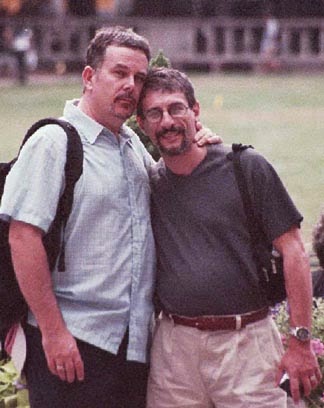
Carlos and his husband Bob at Bryant Park in New York City
I attended college at the National University of Mexico with the goal of becoming a veterinary pathologist and in 1978 I entered the School of Veterinary Medicine. Unsurprisingly, my dinner table conversations constantly revolved around whatever I was studying. During one Christmas break, I visited my Aunt Gloria in Miami and instantly fell in love with the vibrant ocean views and the hot men on the beach. As a gay man, Miami felt like paradise. After graduating in 1984, I officially made the move to Miami, working a 6:00 PM to midnight shift. Driving at night was no problem then. Later I met someone and thought I had it all.
Life in the Fast Lane
I noticed my eyes were getting tired, so I went to a very good optometrist expecting a routine checkup for new glasses. After the standard exam, he examined the back of my eyes. Atropine applied, lens in hand, and light on his forehead, he looked into my retinas. “Look up. Look down. To the right. To the left,” he instructed, and then said, “I’m referring you to a specialist.” When I asked what was wrong, he said,” I suspect you’re developing Retinitis Pigmentosa (RP).”
“I’m what?” Given my profession I was familiar with eye pathology. But, me?
The specialist asked about my family history, but as far as I knew, there wasn’t any. Even so, the diagnosis of RP was confirmed, and I was referred to the Bascom Palmer Eye Institute for an Electroretinography (ERG) test. It felt like pure torture sitting in a completely dark room, enduring drops to dilate and then numb my eyes. After placing tiny electrodes on me, they positioned me in front of an intensely bright screen that fired flashes in every direction to measure my retinas’ electrical response to light. The results were devastating and by all accounts, I should have gone blind long before. Still, I pushed forward. By 2001, life felt good again, until one dark night brought a terrifying wake-up call.
I was sitting at a two-lane intersection, waiting to make a left turn. There was no dedicated left-turn arrow. I looked and decided I could turn. Out of nowhere, a huge SUV slammed into my small car, crushing it like an eggshell. Luckily, I was driving alone; if anyone had been sitting in the passenger seat, they would have been critically injured. I ended up in the emergency room getting stitches across my face, on top of getting a big ticket and having to go to court. I told the judge I didn’t see the other vehicle, it came out of nowhere. The judge accepted my explanation, and I paid the fine, assuming it was one unlucky evening. Until…
I tried a rudimentary device at a scientific exhibition meant to measure peripheral vision and discovered mine was significantly narrower than normal. Crap, I thought ,and wondered if that caused the accident. Then I started having issues with night vision After surviving three major hurricanes in Florida, my partner, Bob, and I moved to Camden, South Carolina. The pitch-black, unlit country roads were a nightmare to navigate. Yet, on bright, sunny days, I stubbornly kept speeding down the highways, clinging to my old life.
Unfortunately, the narrowing of my vision started to affect my daily life. It led to an embarrassing incident when I didn’t see a co-worker extend a hand to greet me and assumed I didn’t want to shake their hand. I apologized and explained that I literally didn’t see his hand. From that day on, I made a rule to always extend my hand first. I had learned to play the trumpet and had played for a band for several years, but sadly I started having problems reading the notes. I had the music enlarged, bought different pairs of reading glasses, and eventually used an iPad set to dark mode. But things were getting worse and my driving was getting bad. After getting blinded by the sun one morning driving to work and narrowly avoiding an accident, I realized my driving days were over.
A retina specialist referred me to a low-vision clinic in Charleston. After a battery of tests, a doctor looked at me and bluntly announced that my right eye had almost no functional vision left and that I was seeing almost entirely out of my left eye. His delivery lacked bedside manner, but testing each eye individually proved he was right. I was in serious trouble, feeling scared and angry but the worst was yet to come. A vision rehabilitation counselor asked me a series of questions before standing up and handing me a white cane. I immediately rejected the idea of using one, but she gave me no time for a meltdown. She showed me how to hold the handle, told me to follow her up and down the hallway, and instructed me not to look down at the floor, but to let the cane guide me. I wanted to cry right there in the corridor. Me, the speed demon, reduced to this?
Rebuilding Phase
Stephen Hawking once said that intelligence is the ability to adapt to change. Helen Keller said that the problem is not blindness, but how to deal with it.
While blindness affects the individual, family and friends also have to learn how to navigate it. As I struggled to adapt, Bob and I frequently clashed. One night outside a restaurant, he walked ahead of me in the dark while I stood frozen, furious at him and at my failing vision, completely ruining dinner. Instead of accepting my new reality, I clung to whatever eyesight I had left, rotating through optometrists for glasses that only worked for months at a time, while keeping my white cane tucked away in denial.
Living together forced us to adapt. We quickly discovered that vague words like “here” or “there” were useless to me; like the night Bob tried directing me to a roach in our bedroom, only for it to escape because I couldn’t see where he was pointing. To solve this, we developed a system using clock positions for direction. The next time a roach appeared, he gave me the exact coordinates: by the door at eight o’clock. That time, the roach wasn’t so lucky.
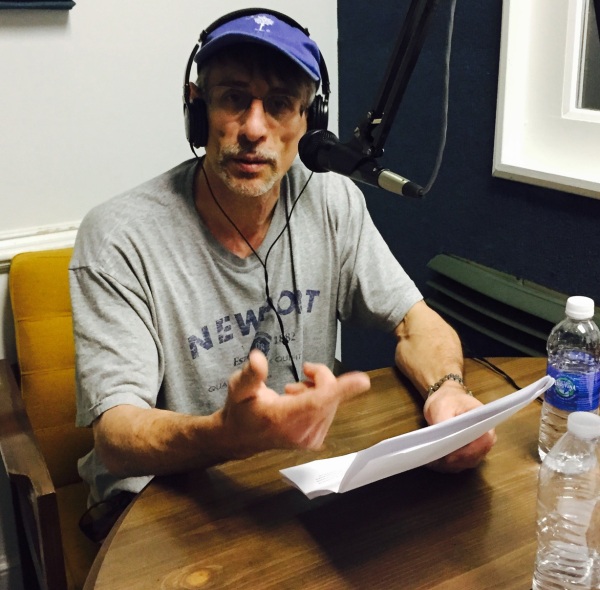
Caros in 2017 doing a radio talk show he created at a local South Carolina talking about substance abuse disorder, HIV awareness and domestic violence
Eventually, I joined the South Carolina Commission for the Blind, where I met positive blind individuals living prosperous lives. A patient trainer taught me how to properly use a folding cane, restoring my confidence, while teaching Bob how to walk with me and be an effective sighted guide. When my vision deteriorated to severe tunnel vision, I applied for disability. It was granted immediately with Usher Syndrome being listed as the reason for disability. The Commission trained me on screen-reading software like JAWS, teaching me to navigate emails, Excel, Zoom, and the VoiceOver features on my iPhone. Suddenly, I felt alive again. I even studied and became a certified court interpreter, launching a brand-new career right from my desk.
Then, a woman named Gloria from the HIV Planning Council (HPC) called to invite me to join a new Hispanic initiative. I initially declined due to my blindness, but she urged me to reconsider. When she called back a week later, her persistence paid off, and I agreed to a six-month commitment. In South Carolina, I partnered with the Department of Health to support Hispanic communities, veterans, and unhoused individuals by conducting HIV testing, delivering educational lectures, and connecting people to essential care. After years of advocating for better resources, Gloria and I co-founded Orgullo & Salud (Pride & Health). I eventually rejoined the HPC as a voting member and was invited to present as a speaker at the annual South Carolina HIV Conference.
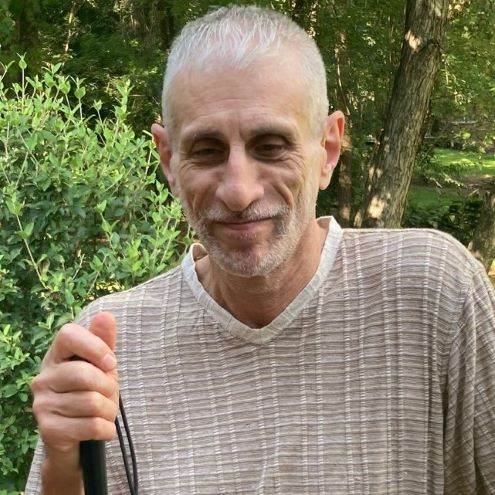
Carlos in 2026 holding his white cane standing on his back deck at his home in Camden
Nowadays, I never leave home without my white cane. In fact, I have two: a nice one for daily travel, and an old, battered one I use while gardening to check the bushes for snakes! With the help of a talented local organist, I even developed a system to memorize music, allowing me to play again without reading sheet music.
When life hands you lemons, make lemonade.
Losing your sight is a heavy blow. I can no longer look out at the majestic ocean, admire a rose, read a book on paper, gaze at a hot guy standing next to me, or drive a fast car. But life goes on, and brain comes to the rescue. You learn to rely on the senses you previously neglected. I had to relearn everything; from walking through my house without hitting anything, to walking by mslef in the court house supermarkets. I can still cook Thanksgiving dinner without burning the house down!
Living in a small town, most people are kind and willing to help me. I learned that there are really only have options; become an angry, bitter grump who refuses to adapt or have a sense of humor, take life lightly, and keep living. I choose option two every single time.
When the lady at the local deli counter hesitated over what to call me or how to get my attention, I lightheartedly told her to call me Mr. Magoo or simply tap my arm when the food was ready. Another time, when a curious stranger in the grocery checkout line asked about my long cane, I told him that I kept an even longer one in my car to sweep along the asphalt while steering with one hand. Bless his heart, he looked at me wide-eyed and almost believed I actually drove that way.
Laughter really is the best medicine. Life will constantly throw unexpected detours your way, challenging your dreams and altering your path. But as you navigate the dark, never forget three magical words:
Yes—I—Can.
Explore more Blog posts
Swimming for a Cure: Support USH X Swim Alcatraz 2026 by Pam Aasen
blog Swimming for a Cure: Support USH X Swim Alcatraz 2026 by Pam AasenSeptember 17, 2026 In 2009, when Ethan was seven and Gavin was five, our family received the Usher syndrome type 1b diagnosis that completely rewrote our lives. We already knew our sons had...
Life in the Lab: How Do We Know If a Potential ASO Therapy Works? by Katerina Anamisis
blog Life in the Lab: How Do We Know If a Potential ASO Therapy Works? Spoiler: It's more complicated than you might think. by Katerina AnamisisAugust 26, 2026 In my last blog, The Diagnosis that Changed my Trajectory, I shared how my brother’s diagnosis of Usher...
The Starting Line by Sara Jessick
blog The Starting Line by Sara JessickAugust 25, 2026 My First Usher Syndrome Conference I stood near my apartment door, my carry-on suitcase full of clothes that I had carefully curated for several “first-impression moments” in my immediate future. And despite being...
Help us find treatments and a cure.